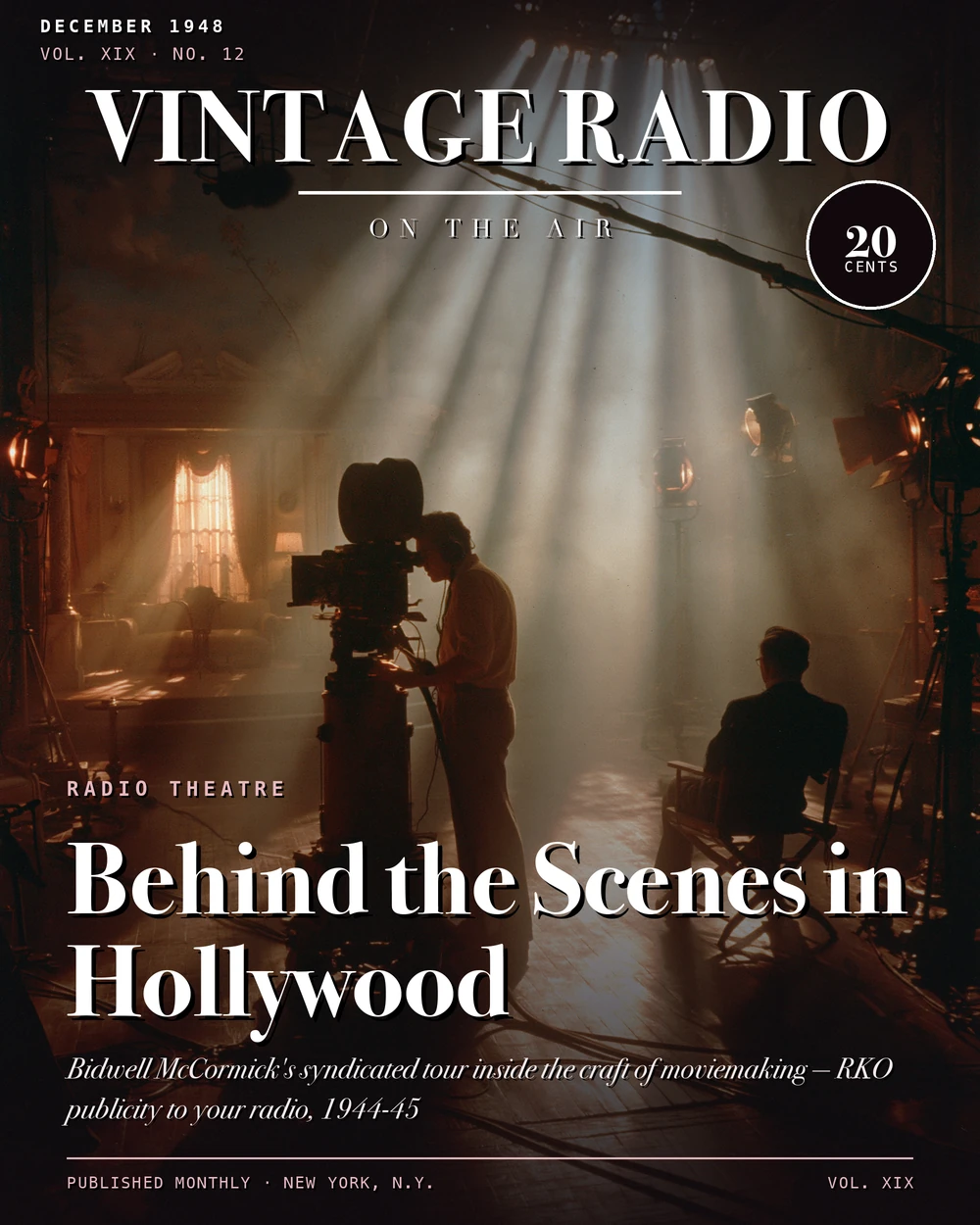
Behind the Scenes in Hollywood
The Man Who Brought the Studio to the Radio
The premise of Behind the Scenes in Hollywood was straightforward: take everything a studio publicity man knows about how movies actually get made, and share it with a radio audience. Bidwell McCormick worked in the publicity department at RKO Pictures, and somewhere in that job he developed what anyone who listens to the surviving episodes would recognize as a genuine, encyclopedic passion for filmmaking — not just the stars, but the craft behind them. He put together a weekly quarter-hour syndicated program, recorded at Allied Recording studio, and set out to tell radio listeners what really went into bringing a finished film to a theatre screen.
McCormick opened each episode with a statement of purpose: to let listeners learn "at first hand all the interesting, colorful things that bring a completed movie picture to a theatre screen," by talking with stars, directors, artisans, cameramen, authors, producers, screenwriters, and stand-ins. That's a wide brief, and the show largely delivered on it. Whether RKO itself was institutionally involved in the program is uncertain — McCormick appears to have handled the syndication himself, and the series covered actors and films from all major studios, not just RKO.
The exact timing of the series sits in a small fog. Recording dates noted in one archive point to January 1944, though sessions were likely spread over weeks or months. A certified compilation lists the 18 surviving episodes as produced in 1945. Other sources call it a 1944 syndicated series. The honest answer is that the show dates to roughly 1944–1945, and the ambiguity in the sources has never been fully resolved.
How the Show Was Put Together
McCormick was not a trained broadcaster, and the surviving episodes reflect that — his on-air delivery was unpolished. What carried the program was the material itself. To keep things moving, he worked alongside two co-voices: Nathan Hale, who may have been a pseudonym used by an actor working at Allied Recording, and Nona Rey (also listed in some sources as Manna Ray Eule). The three of them alternated stories and narrated segments to give the program variety and pace within its ten-to-twelve-minute running time.
The format was documentary in character — narrated stories rather than live in-studio celebrity guests or recorded interview sessions. Despite what the show's title might suggest, the personalities of Hollywood were discussed and profiled in depth, but through McCormick's narration and his co-hosts reading prepared segments, not through sit-down interviews. That distinction matters because it explains the show's range: McCormick could cover anyone in the industry, any studio, any production, without being limited to whoever could be booked for a broadcast.
What the Episodes Actually Covered
The 18 surviving episodes range from star profiles to technical deep-dives, and that breadth is part of what makes the series interesting. On the personality side, the show profiled Paulette Goddard, Van Johnson, Irene Dunne, Joan Blondell, Paul Lukas, Cary Grant, Virginia Mayo, Hedy Lamarr, Ronald Colman, Danny Kaye, Pat O'Brien, Dick Powell, Edward G. Robinson, Billy Barty, Claire Trevor, and others. Some of these were the biggest names in Hollywood at the time; others were character actors and supporting players who rarely got their own radio segments.
The technical episodes are equally varied. One covers the work of sound technicians and the mechanics of dubbing actors. Another explains how Disney combined live actors and animated characters in The Three Caballeros (1944). One episode details the creation of breastplates for The Robe, the 20th Century Fox biblical epic — a film whose production history had roots at RKO in the 1940s before the rights moved to Fox, where it eventually became the first film released in CinemaScope in 1953. One episode explores how a Hollywood studio functions like an industrial plant. Another looks at the ban on sightseers during active film productions.
There are episodes that are harder to categorize but no less specific. One covers the process of obtaining photogenic ice for a Sonja Henie picture — the kind of logistical challenge that most moviegoers would never think about. Another addresses Rita Hayworth's aversion to man-made fog on set. These are exactly the sort of details that publicity work puts you in a position to know, and McCormick brought them to a general audience that had no other way to hear them.
A Detail Worth Remembering
One of the show's most vivid factual segments involves the relationship between color and black-and-white film. In 1945, roughly 90 percent of movies were shot in black and white — but all sets were built in full, living color. The reason, as the show explained it, was that cinematographers found actual colors produced a better look on film than shades of gray painted directly onto sets. A photograph of a room actually painted in realistic colors looks different from a photograph of a room painted in gray tones, and the difference showed on screen.
That kind of fact — precise, counterintuitive, and grounded in the actual work of making films — runs through the series. McCormick also covered scenery painting as its own craft, the logic of costuming choices, and how book options for upcoming films worked as a business matter. The show functioned partly as a trade and entertainment update for general audiences, mixing craft knowledge with gossip and star coverage in a way that kept it useful across a range of listener interests.
What Survived and How
The recordings that make up the surviving collection were found among Bidwell McCormick's estate after his death. The collection was certified and released in October 2017, preserving all 18 episodes. Total playtime across the set runs approximately three hours and forty-eight minutes — a compact archive, but a coherent one. The episodes hang together well enough to give a clear picture of what McCormick was trying to do and how consistently he managed it.
For a program made by one studio publicity man working outside the normal broadcast infrastructure, Behind the Scenes in Hollywood covered a remarkable amount of ground. It was honest about what moviemaking actually involved, episode after episode, without reducing everything to star glamour or studio promotion. That instinct — to treat the craft as interesting in itself, not just as a backdrop for celebrity — is what gives the series its staying power.